



Inside Cleveland Institute of Art’s New Lab
By Carlo Wolff

Atop the CIA XR Studio, Matthew McKenna and Rachel Yurkovich survey the heart of the Integrated Media Lab, where virtual production and hands-on innovation meet.
Photo courtesy of CIA
For many Cleveland Institute of Art students, the journey to the future starts on the bus. Their ride from University Circle to East 66th and Euclid takes them not just across town, but into the CIA’s new Integrated Media Lab — a 14,000-square-foot creative playground where they can spray-paint stencils one hour and step inside a virtual snowstorm the next. Tucked inside the MidTown Innovation Center, the $13 million IML is CIA’s boldest move yet to keep its students ahead of a fast-shifting creative and technological landscape.
A collection of interconnected teaching and learning spaces in the city’s Hough neighborhood, the IML is designed to spark collaboration and exploration. Since its formal opening Sept. 19, the lab has introduced students to a range of emerging technologies, giving them room to test ideas, build skills and see where the tools of tomorrow might take their work.

In the Arcade, CIA students dive into game design, interactive storytelling, and the technology shaping tomorrow’s digital worlds.
Photo courtesy of CIA
But the IML is more than a suite of high-tech rooms. It represents a larger ambition. As Kathryn Heidemann, CIA’s president and CEO, puts it, the goal is to create “a whole new market space for the value of creatives in all sectors, not just in arts and culture,” she says. The lab’s design intentionally blurs the lines between classroom and industry hub, fostering collaboration with businesses, cultural organizations, and startups across Cleveland. It’s the kind of investment that could reshape what’s possible—for students, for Cleveland, for Ohio. “There’s nothing else like it in the state,” Heidemann says -or, for that matter, at many art and design colleges across the country.
Inside, the IML hums with activity. Students move between specialized spaces and hands-on tools that bring their ideas to life. The Experience+Edit Center and the Arcade support game design and digital storytelling. Dedicated Spaces and Studios open doors to making and experimenting across any medium. At Equipment Checkout, VR/AR headsets, 3D scanners, professional cameras and motion-capture gear are all in reach. The lab’s recording studios support audio, music and podcast production. And throughout the building, facilities built for virtual production allow students to test ideas at full scale.
At the heart of the lab is the two-story extended-reality XR Studio — the “crown jewel” of the IML, says Matthew McKenna, CIA’s vice president of technology and digital strategy and chief information officer. Digital waves, sunsets, snowfall and more can be rendered inside the LED volume, made to integrate physical objects with virtual environments for commercials and films. From an educational standpoint, it offers a real-world experience for students exploring contemporary cinematic technologies.
“We can do motion capture in this space along with virtual production,” McKenna says. “We have a garage door that opens right into our space. We can drive a vehicle in or load equipment in. The fact that we’re in Midtown Cleveland, equally distant from downtown and University Circle, is a game changer. Every other studio I’ve been that has virtual production capabilities is in an industrial parkway or some back lot. We’re in the middle of a city.”
Opening Doors
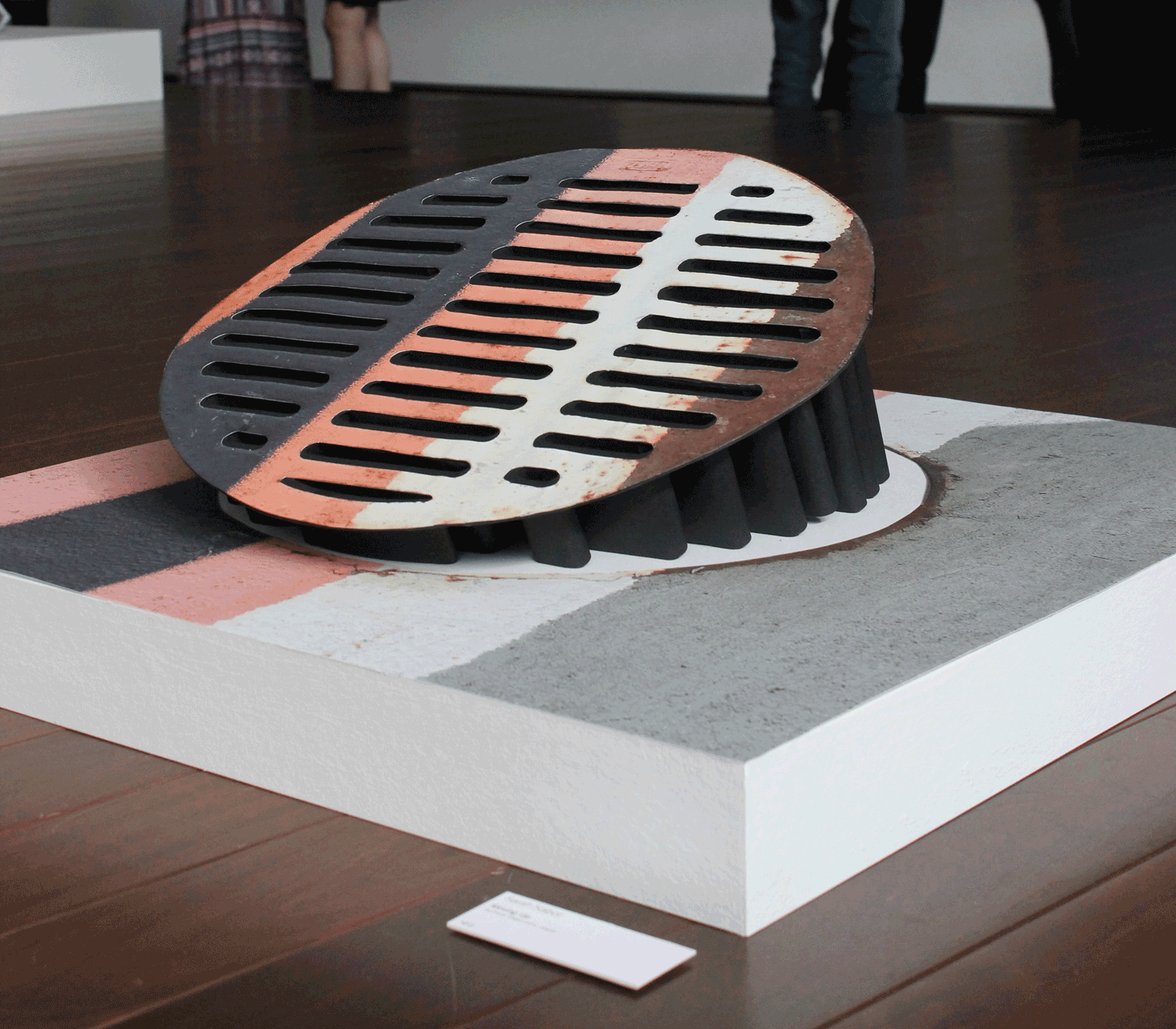
The IML’s entrance doubles as a gallery. For the opening celebration, it showcased “Portals,” a project conceived by faculty member Nicole Condon-Shih and executed by her students.
“It was part of our course called Studio Discovery,” says Condon-Shih. “This was a two-week workshop, and the goal was to have students be exposed to how to make paper stencils and use spray paint to make analog physical works on paper.”
In the first week, students developed basic shapes in Adobe Illustrator and cut vinyl at CIA’s print center. In week two, they moved the work into the IML.
After learning the equipment, students became “the curators of their own exhibition,” Condon-Shih says. “So they took the 2D pieces that they made with the spray paint and their vinyl pieces were the frames, if you will, and made a collaborative piece. The best part about this was the IML component.” Once complete, the students photographed their work to view on VR headsets, allowing them “to look around and be immersed within what they created in 2D,” she says.
Sacha Elliott, a first-year Foundation student, says “Portals” turned out better than expected, even though they didn’t immediately take to spray painting. So much was new, they say, but that was part of the excitement. Condon-Shih allowed the class to design their own gallery arrangement.
“This freedom stumped us a bit, but once we figured it out, I feel like it helped us make a more creative product than a professional gallery arranger may have produced, but it also looked less professional,” Elliott says. “Learning new skills made it super fun, and the VR aspect was interesting and tied in well with the spray paint because spray paint has such nice texture.”
George Ramirez, an assistant professor of Media Studies, says the IML has been central to shaping his liberal arts class.
“We did a reading on the history of computer graphics and talked about the transformation from physical object to its digital form,” he says. “Then we were able to go to the IML and do a 3D scanning demo so students could understand the process rather than just read about it. So for me, the IML has been central to getting students to embody and interact with these technologies so they understand the critiques that media study scholars, art historians and other fields in the humanities are making about these media.”
The Long View
Heidemann joined CIA in 2019, when early conversations about the IML were underway. In 2020, then-President Grafton Nunes asked her to further develop the concept and push it toward reality.
Funding for the IML came from a mix of public and private sources, including individual donors, foundations and the State of Ohio. Cleveland Development Advisors, an affiliate of the Greater Cleveland Partnership, was a key funder, providing $8 million in federal and Ohio New Markets Tax Credit allocations to support the project.
The vision sharpened further after the Cleveland Foundation announced plans to move its headquarters to MidTown and sought partners for a collaborative venture. (Other partners in the MidTown Innovation Center include Case Western Reserve University, the Assembly for the Arts O.H.I.O. Fund, University Hospitals, JumpStart and Hyland Software.)
For Heidemann, the question driving the project is simple —
and expansive. “How can we leverage the Interactive Media Lab to show the relevance of art and design education?” she asks. The answer touches not only CIA’s traditional fields but also healthcare, medicine, technology, education, hospitality and entrepreneurship.
Making those connections is a win for business and industry, and it helps address the pressures facing higher education: declining enrollment, population shifts and growing public mistrust. By positioning art and design at the center of cross-sector innovation, Heidemann hopes to open new pathways — for students and for the region.
“It’s within those creative synapses where those interdisciplinary ideas come together to create something new,” Heidemann says. “That’s creativity. That’s something we nurture here.”